
Predictive maintenance sensors convert machine signals into early warnings that prevent unplanned downtime. By measuring variables like vibration, temperature, electrical behavior, magnetic flux, acoustic emissions, humidity, and speed, these devices detect mechanical and electrical faults long before breakdown.
Proper placement and continuous sampling allow predictive maintenance sensors to identify bearing wear, imbalance, misalignment, rotor bar defects, arcing, cavitation, and moisture ingress. Modern multi-parameter sensors simplify deployment and scale quickly across assets. This guide explains the top sensor types, what each detects, installation best practices, and how multi-channel analytics transform raw condition data into prioritized maintenance actions.
TLDR:
Predictive maintenance sensors monitor vibration, temperature, acoustic emissions, magnetic flux, RPM, humidity, and electrical signals to detect early-stage faults before breakdowns.
Multi-parameter devices like Nanoprecise’s MachineDoctor combine these measurements in one sensor, improving diagnostic accuracy, simplifying deployment, and enabling prioritized maintenance actions that reduce downtime, lower costs, and extend asset life across industries.
What Are Predictive Maintenance Sensors?
Predictive maintenance sensors are industrial condition-monitoring devices that measure physical, electrical, and environmental signals from operating equipment. These measurements reveal early-stage failure modes before catastrophic failure.
Proper condition monitoring sensors will align with condition monitoring frameworks referenced by ISO (ISO 17359) and industrial reliability practices supported by SMRP.
Top Predictive Maintenance Sensor Types and Use Cases
1. Vibration Sensors
Vibration sensors are the foundation of predictive maintenance, especially for rotating machinery. They detect mechanical faults early by monitoring oscillations in motors, pumps, gearboxes, and other critical equipment. They detect:
- Bearing wear
- Imbalance and misalignment
- Structural looseness
- Gear or coupling defects
When deployed as part of a multi-parameter predictive maintenance solution like Nanoprecise, vibration sensors deliver early warnings, prioritized alerts, and actionable insights, helping maintenance teams reduce unplanned downtime and extend asset life.
2. Acoustic & Ultrasonic Sensors
Acoustic and ultrasonic sensors detect high-frequency energy that traditional vibration sensors may miss, providing early warning of faults in mechanical and electrical systems. They detect:
- Early bearing distress before it shows in vibration trends
- Air and gas leaks in compressed air or pneumatic systems
- Cavitation in pumps
- Electrical arcing and insulation issues
- Steam trap failures
These sensors are particularly valuable in compressed air systems, hydraulic circuits, and high-voltage environments, where early detection of anomalies can prevent unplanned downtime and costly repairs. Combining acoustic data with vibration, temperature, and electrical measurements improves multi-parameter correlation and diagnostic confidence.
3. Temperature Sensors
Temperature sensors, including RTDs, thermocouples, and infrared devices, monitor heat signatures to reveal early signs of mechanical or electrical issues.
- Overheating bearings
- Lubrication breakdown
- Electrical connection failures
- Motor overload
For predictive maintenance, temperature trends over time (delta-T) are more meaningful than single absolute readings. Continuous monitoring allows teams to identify gradual hotspots, verify vibration alerts, and correlate with other multi-parameter signals for accurate fault diagnosis.
4. Magnetic Flux Sensors
Measures electromagnetic field distortion in motors. Detects:
- Broken rotor bars
- Stator winding faults
- Air-gap irregularities
- Early electromagnetic degradation
Magnetic flux analysis strengthens motor diagnostics when paired with vibration and current data. To see how Nanoprecise measures Magnetic Flux, with the MachineDoctor sensor check out the video below:
5. Current, Energy & RPM Monitoring
Current and energy monitoring sensors analyze electrical signatures to detect both mechanical and electrical faults. By measuring current, voltage, harmonics, and power usage, these sensors reveal issues that vibration alone may miss. They detect:
- Phase imbalance or voltage irregularities
- Harmonic distortion
- Rotor bar or winding defects
- Load fluctuations or operational inefficiencies
- Energy waste
RPM estimation: In many AC motors, RPM can be inferred from electrical frequency and motor slip, providing useful speed correlation for diagnostics. For higher precision, dedicated speed sensors or vibration-derived measurements can complement electrical data. Combining RPM with current and energy trends improves root-cause analysis and predictive maintenance insights.
6. Humidity Sensors
Humidity sensors are typically installed in enclosures, electrical cabinets, or near breathing paths to monitor environmental conditions that can affect machinery reliability. They detect:
- Moisture ingress from leaks or condensation
- Condensation risk under temperature swings
- Insulation degradation in electrical components
- Corrosion conditions on metal surfaces
These sensors are critical in mining, food processing, cement, and outdoor installations, where moisture can accelerate wear, compromise electrical insulation, or trigger unexpected failures. Integrating humidity monitoring with vibration, temperature, and electrical data enhances predictive maintenance by identifying environmental stressors before they cause damage.
7. Multi-Parameter Sensors
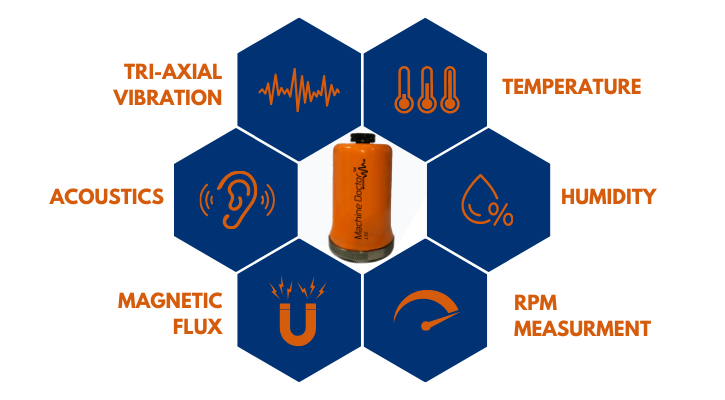
Modern multi-parameter sensors combine different parameters like vibration, temperature, acoustic, magnetic flux, RPM, and humidity monitoring into a single device. By capturing multiple channels simultaneously, these devices provide more complete insights into asset health and reduce the complexity of deploying multiple individual sensors.
Benefits:
- Fewer devices per asset
- Faster enterprise rollout
- Improved signal correlation
- Reduced wiring and bandwidth
- Scalable fleet monitoring
Multi-parameter devices like MachineDoctor simplify installation, accelerate data collection, and deliver AI insights that help maintenance teams prioritize actions and prevent unplanned downtime.
Benefits of Predictive Maintenance Sensors
Predictive maintenance sensors deliver measurable impact. A European Commission–supported research project found that predictive maintenance implementation led to a ~88% reduction in equipment downtime in trial use cases, along with improved maintainability and OEE gains.
Other benefits of implementing Predictive Maintenance Sensors include:
- Lower Mean Time to Repair (MTTR)
- Increased asset lifespan
- Improved safety
- Reduced emergency maintenance costs
- Better maintenance planning accuracy
- Energy efficiency improvements
- Higher production reliability
| Sensor Type | Primary Use | Key Benefit |
| Vibration | Detect bearing wear, imbalance, misalignment, looseness | Early mechanical fault detection. |
| Acoustic / Ultrasonic | Identify cavitation, leaks, arcing, early bearing distress | Detects faults earlier than standard vibration alone. |
| Temperature | Monitor heat rise in bearings, motors, electrical connections | Confirms overload and lubrication breakdown. |
| Magnetic Flux | Detect rotor bar defects and stator faults | Identifies motor degradation before mechanical escalation. |
| Current / Energy | Measure electrical signature, harmonics, load changes | Reveals inefficiencies and phase imbalance. |
| RPM / Speed | Confirm operating state and shaft speed | Improves spectral accuracy and diagnostic precision. |
| Humidity | Detect moisture ingress in enclosures | Prevents insulation failure and corrosion. |
| Multi-Parameter Sensors | Combine vibration, acoustic, temperature, magnetic flux, RPM, and humidity in one device | Higher diagnostic confidence, fewer devices per asset, faster scaling, reduced false positives. |
How Predictive Maintenance Sensors Detect Failure Modes with a Multi Channel Focus
Predictive maintenance sensors convert raw equipment signals into actionable insights by continuously monitoring vibration, temperature, acoustic emissions, magnetic flux, RPM, humidity, and electrical behavior, with each sensor type targeting specific fault modes.
By capturing multiple parameters simultaneously, correlating trends, and analyzing changes over time, multi-parameter sensors like Nanoprecise’s MachineDoctor detect early-stage failures before breakdowns occur, reduce false positives, and prioritize maintenance actions, giving teams the visibility they need to act decisively and prevent unplanned downtime.
Industries That Use Predictive Maintenance Sensors
Predictive maintenance sensors are industry‑agnostic — any operation with critical rotating or electrical assets can benefit from early fault detection and prioritized maintenance actions.
Nanoprecise’s multi‑parameter predictive maintenance sensors and platform are a top choice for many leaders, backed by recognition from a large variety of industry awards and trusted by global organizations across many industries, including:
- Oil & Gas
- Mining & Metals
- Cement & Aggregates
- Automotive Manufacturing
- Energy & Utilities
- Food & Beverage
- Pharmaceuticals
- Pulp & Paper
Nanoprecise’s credibility is supported by multiple independent recognitions — from Deloitte’s Technology Fast 500 and Frost & Sullivan Best Practices Awards to Global Growth Distinction awards and product innovation accolades — reflecting innovation, growth, and trusted performance in the predictive maintenance domain.
Conclusion
Predictive maintenance sensors are essential tools for modern industrial reliability programs, providing early warning of mechanical, electrical, and environmental faults. By integrating multiple measurement channels—vibration, temperature, acoustic, magnetic flux, RPM, and humidity—into a single solution, maintenance teams gain complete visibility, actionable insights, and faster response times.
Multi-parameter predictive maintenance sensors, such as Nanoprecise’s MachineDoctor, deliver measurable impact: reducing unplanned downtime, improving asset lifespan, increasing safety, and enabling energy efficiency. Industry-agnostic and scalable, these sensors are a top choice for global leaders across oil & gas, mining, manufacturing, energy, and more, supporting smarter maintenance strategies and long-term operational excellence.
About Nanoprecises’ Predictive Maintenance Sensors
Nanoprecise provides multi-parameter predictive maintenance sensors that monitor vibration, temperature, acoustic, magnetic flux, humidity, and electrical signals. Integrated with analytics and CMMS platforms, they deliver prescriptive insights that turn raw machine data into prioritized maintenance actions. These sensors help industrial plants reduce downtime, lower maintenance costs, and extend asset life on critical machinery.
FAQ
Yes. Modern predictive maintenance sensors monitor multiple variables beyond vibration, including temperature, acoustic emissions, magnetic flux, humidity, electrical current, and rotational speed. Multi-parameter sensors provide a holistic view of machine health and help prioritize maintenance actions across assets.
Sensors collect real-time equipment data that feeds into analytics platforms. Vibration, temperature, and acoustic signals reveal early signs of wear, imbalance, misalignment, or electrical faults. Predictive maintenance software then turns this data into prioritized alerts, reducing unplanned downtime and improving operational efficiency.
The main types include:
-Vibration sensors
-Acoustic/ultrasonic sensors
-Temperature sensors
-Current and magnetic flux sensors
-Humidity and environmental sensors
Look for sensors that are accurate, ruggedized, and scalable, with secure wireless or IoT connectivity. Evaluate wireless sensors, remote condition monitoring capabilities, and multi-parameter options. Check independent reviews, case studies, and vendor certifications for credibility.
A wireless condition monitoring sensor transmits vibration, temperature, or other data to a central system without physical cabling. These IoT-enabled sensors allow flexible deployment across industrial plants, simplify installation, and enable remote monitoring of critical machinery.
Remote condition monitoring sensors continuously measure equipment health and transmit data to cloud or on-prem analytics platforms. They are widely used in industries like oil & gas, mining, and manufacturing to detect faults early, schedule maintenance efficiently, and reduce unplanned downtime.
Learn more.